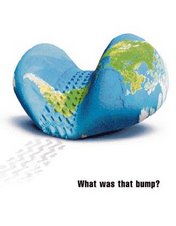
I'm readng this book right now called "The World Without Us" which is this kind of cool thought experiment about what would happen to civilization if humans just disappeared today. What would happen to buildings, roads, farms, power plants, oil refineries, etc.
One chapter was about polymers, what will happen to plastics. Right now...nothing would happen to them. There is no mechanism to break them down. They can get smaller and smaller, but they never go away. As they get smaller, animals eat them at all levels of the food chain. Some particles are so small that krill and plankton eat them. Some companies make facial "srubs" that contain tiny plastic beads...these wash directly into waterways where the smallest members of the food chain eat them.
The worst thing in that chapter was about how much plastic is in the ocean...right now there is a floating "ocean" of plastic debris the size of the African continent in the middle of the pacific ocean. You can see it from space. Isn't that the most sickening thing ever?
Whenever I hold a piece of plastic in my hand...I can't help but think about where it came from and where its going. What did it take to make this, and what will happen to it when i throw it "away". Will it end up in the ocean, where some animal will eat it and die? Or will it just go to a landfill where it will likely remain for the next million years until some bacteria evolves to digest polymers? What toxins were poured into the air and water during its manufacture?
I want to stop consuming plastic, i really do. Is it even possible? What do we buy that comes in plastic, and is there an alternative?
Cleaning products
soap (like castille)
laundry soap
dish soap
shampoo/conditioner
food that comes in plastic containers like bottles of oil, etc.
food in plastic bags such as crackers, etc
bread bags
occasionally shopping bags
i think we can start getting shampoo, conditioner, and laundry soap in bar form. i'm looking into it.
food...we just need to recommit to not buying a bunch of packaged crap. sigh. its hard!
Showing posts with label Resource consumption. Show all posts
Showing posts with label Resource consumption. Show all posts
Wednesday, February 20, 2008


Monday, February 18, 2008
Spring cleanin'
Ok, so it's not really spring yet. But it certainly feels that way thanks to 3 days of sunny over-fifty degree weather.
This inspired us to get some stuff done. Well, actually what inspired us was that we were out taking a walk, and our neighbor was putting a Very Nice Futon out on the curb. We were all "ho ho, what's all this then? This is much better than our shitty futon." See, our computer/guest/random piles of crap room has this futon in it that came from my stepmom Marie's friend Diana. I think Diana bought it like 20 years ago or something because it is more comfortable to sleep on the ground than to sleep on this thing. Seriously. After my stepmom got some years of use out of it, it sat in their basement somehow getting more and more "firm" (read: hard as a rock). And also uglier. Its frame was painted black at some point and a very ugly tropical-plant themed futon cover was placed on it.
Well, on this day, our Lucky Day, our neighbor was putting out a nice wooden futon frame with a nice brown neutral-ish colored cover. And it was still soft! So we had to get it in the car to get it home. This caused us to notice that our car is full of massive piles of crap. So jay totally cleaned the car out, vacuumed, it etc.
This caused us to notice that our computer room was totally cluttered. Which caused us to notice a similar thing about the rest of the house. So we spent the next two days putting crap on the curb for people to help themselves to, putting many belongings on the free section of craigslist (including our old futon which was taken in a record 5 minutes), and aquiring an item like this on craigslist for elsie's room to put toys, books, etc. This caused us to notice that the kids have far too many books, several of which we hate and would be glad to never read again, so a lot of those went, too.
All in all, we totally organized our computer room, elsie's room, the toys in the living room, the backyard, the kids books, the bookshelves, the car, and some of our bedroom. And we went on several walks, spent a lot of time outside, did some yardwork, etc. It was a pretty successful weekend.
We are keeping a decluttering tally on the right hand sidebar. So far we've gotten rid of like 250 things. We have given up completely on all items that "may have some future use if a bunch of things change." If we aren't using it now, it goes. If we don't love it, it goes. We've also given up on "maybe we can sell this." No. Things aren't going to get sold. We aren't going to deal with that. We hold on to things because maybe someday we will get it together and have a garage sale. Sooooooooo not going to happen.
So...so far, we have decluttered, organized, and gotten rid of all non-necessary items in:
The kitchen island drawers and cupboards
Elsie's bedroom
Elsie's closet
All books, kids, adults, etc.
The living room toys area
The computer desk/office space
The office bookshelf
The yard (believe me, there was a lot of crap out there, both literally and the non-disgusting kind)
some of the garage
the two hall closets (except the top shelf!)
the entire computer room
The minivan
We have left to declutter/organize/get rid of junk in:
Office room closet
our bedroom closet
top shelf/medical type supplies in hallway closet
bathroom (should be somewhat easy, there isn't too much in there)
kitchen cupboards
rest of the garage
the camry. if it doesn't die first.
oh, and steam clean the carpet
we're getting there...
It feels so good to get rid of stuff. It just feels so liberating. I fought back the urge to go to Ikea this weekend and buy a bunch of organizing stuff. It seems stupid to buy stuff when you are trying to get rid of stuff...but that is the grip our consumer culture has on us, i guess. I think I might get some plastic totes off craigslist or something to store winter clothes during the summer, etc. But I don't need to get it new. The organizer thing I got for elsie's room was $25 on craigslist. A similar thing at target is anywhere from $60 to $90. At Ikea its $60 to $130. Jeez! just for some plastic bins on a shelf. Lame.
Wednesday, January 30, 2008
The Story of Stuff
A short video to make you think about stuff. You know, like things.
http://storyofstuff.com/
The nice thing about doing The Compact (see sidebar) as we have been now for about 7 months (I can almost count on one hand the total amount of things we have purchased new this past year) is that your desire to consume just grows less and less. This also goes hand in hand with decluttering. You realize how much time you spend cleaning and otherwise managing the chaos of items in your house--you lose the desire to bring more items into your life.
I really have no desire to shop for anything. I haven't set foot in a mall or big box store for about 2 years. I just don't see the need. There are some items that i've bought new this year, such as underwear and things of that nature, but the level of frivoulous spending for items that aren't absolutely necessary is down to almost nothing. It also helps that we're broke.
Here is a simple-living pledge that I think it would be pretty easy for our family to follow this year, since we already do most of this stuff:
In order to keep our lives simple in 2008 we are going to do the following:
*restrict purchases to needs (exceptions for birthday/anniversary/holiday gifts - everyone needs a toy now and again)
*buy used when possible and practical (exceptions for personal care, undergarments/socks, safety equipment, shoes, and medical needs)
*recognize limits of our day, and do what we can, let the other stuff go, and start new each day
*work on organizing life, home and work so that we can fully enjoy our time, rather than spending it on digging through chaos
*make wise choices about purchasing new goods
*be conscious of the impact we have on the earth and try to minimize our footprint
*spend more time outside
*eat well
*move more
*stop and play with our children every day
*tell each other we love one another every day
Wednesday, July 11, 2007
Eco 'air conditioning'
I fully admit that this might be common knowledge, but I swear from people's reactions to the cool temperature of our house growing up that not everyone does this. Everyone used to come into our house in the summer and ask "do you have air conditioning?" We didn't. We just did this (below) and it kept our house pretty cool.
At night open all your windows. Set up at least one fan (preferably in your bedroom) as an "exhaust fan" blowing out the window, rather than blowing air in from the outside. In the morning when you get up (assuming you get up before 10 am) your house is the coolest its going to be. Shut all the windows, Close all blinds and curtains (especially on east and south facing windows) and leave them that way all day. Our house can be up to 20 degrees cooler inside than outside. Around noon, turn on any indoor fans or ceiling fans to help circulate air. You will probably feel the need to re-open all the windows back up around 5 or 6 pm, at which point your house will be very stuffy and only about 5 or 10 degrees cooler than the outside. Even if you have real a/c this "technique" can make it so you don't have to turn it on until later in the day.
Many cities are facing severe energy problems from air conditioners. I realize that some people live in places where it is 120 degrees, and you kind of have to have a/c. in places like Oregon, it would be nice to have it about 20 days a year, but you can definitely live without it (it did suck yesterday when it was 101 in Portland, but that is rare...) Our neighbor turns on her a/c when the temp gets above about 70. it drives me nuts. your body's internal thermastat can readjust to different temperatures, so if you don't have a/c, in the summer 85 starts to feel not-very-hot. Just try to minimize your a/c use, and keep your thermastat kind of high (like 80 or more). A/C units are really hard on the energy grid (and the environment).
Thursday, July 5, 2007
Party pooper
Ok, I'm going to be negative about one of our country's favorite past-times, and I really don't care if I sound like I'm bitter and jaded (which I am, but that's beside the point).
I HATE THE EFFING FOURTH OF JULY. Blowing things up is for morons.
In addition to the outrageous noise level (which pisses me off to no end) that starts about a week before and goes about a week after the actual holiday, it is horrible for the environment.
To quote (and slightly amend) another blog I saw: The smoke made by fireworks is densely sulphurous, highly acidic and contains a lot of greenhouse gases. Fireworks dump toxic metals like lead, arsenic and mercury into the atmosphere. Besides frightening animals, fireworks poison the environment in a way that is insidious and totally unnecessary. They generate tons of waste. Please limit the number you buy and use to a carefully selected few. Try using lasers, fountains, balloons and musical instruments to celebrate your country rather than turning it into a toxic waste dump.
Our neighborhood last night sounded like a war zone. It was insane. I didn't get to sleep until 3am and that really, really ticked me off. I ended up exchanging heated words with our neighbors. Some people are so inconsiderate. You live in a city. There are very old and very young people here and lots of pets, none of whom appreciate the insane racket you are making. If it was truly just one night, that would be one thing, but it goes on and on and on... and people doing it after midnight are just jerks. That is all there is to it.
I'm so sick of the American "self-entitlement" attitude (as exhibited by my jerk neighbors). You do not have a right to do fireworks. We have access to so many forms of entertainment in this country, but when it is suggested that we stop one (for very good reasons) such as fireworks, the circus, dog racing, etc. people flip out. We are entitled to do whatever we want! We are the greatest nation on earth! Blowing stuff up and generating tons of waste and being obnoxious and loud...it is the most American holiday out there.
The amount of fires set yesterday in Oregon is astounding. New York state banned all fireworks and it was AWESOME. It was so quiet on the 4th, you couldn't hear anything, except maybe a few sparklers. I wish Oregon would follow suit.
Ok, rant done.
Wednesday, June 13, 2007
Line-dry

Sometimes we dry our clothes on a rack like this. We also strung a rope between our fences in the back to line-dry that way.
Why I love to line-dry my clothes:
1. It saves energy
2. It saves money
3. It sanitizes and bleaches. It even bleaches out old stains. It works amazingly well.
4. The clothes smell "mountain fresh" without using a nasty detergent labeled "mountain fresh".
5. It is exercise, and satisfying manual labor (why do we let machines do our work, then pay for a gym membership to go burn energy on a machine?)
6. Elsie likes to help out.
7. It makes things last longer--it reduces wear and tear.
Sunday, June 10, 2007
DIY (Do it yourself)
Wikipedia defines DIY as "a term used by various communities that focus on people creating things for themselves without the aid of paid professionals. Many DIY subcultures explicitly critique consumer culture, which emphasizes that the solution to our needs is to purchase things, and instead encourage people to take technologies into their own hands.
1. Buy grains and beans in bulk. Soak beans in water before cooking. Beans bought this way are SO cheap. Way cheaper than beans in a can. Buy all foods possible in their raw form. You have a lot more packaging and expense when you buy a box of rice-a-roni vs. just buying a big bag of rice.
2. Make your own cleaners. I'm going to post a list of recipes sometime soon. Basically, you can make a cleaner for anything out of vinegar and baking soda. You can make your own bathroom cleaner, laundry soap, shampoo, toothpaste, dish soap, etc. Its incredibly cheap and so much better for the environment than those horrible chemical cleaners. Bleach is the worst. Please, please do not use bleach. It is an endocrine-disrupting dioxin that has a very long half-life. It is horrible for human health and the environment. There are many alternatives to chlorine bleach.
3. Cutting your family's hair. With a little practice, you get pretty good. Jay has had to wear a baseball hat for a few days, but that is rare. Especially for little kids, a homemade hair cut is the best!
4. Grow your own food. Even if you don't have space, you can rent a community garden plot in most cities, or you can container garden with tomatoes, peppers, herbs, etc.
5. Make as much of your own food from scratch as possible. Making your own bread is so rewarding and fun. It only takes about 10 minutes of your actual time, the yeast do the rest. Cook from scratch as much as you can. For example, we make our own seitan (wheat meat), salad dressings, etc. Many things can be made in advance, then frozen or dried for later use.
6. Handcrafts. The best gifts are home-made and will be cherished for a long time. Things like sewing, quilting, knitting, clay/ceramics, crochet, woodwork, etc.
7. Car repairs. Some car repairs are pretty simple and you save yourself hundreds of dollars. Get a manual for your car off e-bay. You can at least change your own oil.
8. Home repairs/home improvement. I'll admit, I'm not the most knowledgeable about this topic, never having owned a home. But i've been told that with some good books and perhaps a class or two, it is very do-able.
The actual activity of DIY goes back through the ages--since the beginning of time, people have used their own abilities and available tools and technologies to take care of their own needs, make their own clothing, and so on."
1. Buy grains and beans in bulk. Soak beans in water before cooking. Beans bought this way are SO cheap. Way cheaper than beans in a can. Buy all foods possible in their raw form. You have a lot more packaging and expense when you buy a box of rice-a-roni vs. just buying a big bag of rice.
2. Make your own cleaners. I'm going to post a list of recipes sometime soon. Basically, you can make a cleaner for anything out of vinegar and baking soda. You can make your own bathroom cleaner, laundry soap, shampoo, toothpaste, dish soap, etc. Its incredibly cheap and so much better for the environment than those horrible chemical cleaners. Bleach is the worst. Please, please do not use bleach. It is an endocrine-disrupting dioxin that has a very long half-life. It is horrible for human health and the environment. There are many alternatives to chlorine bleach.
3. Cutting your family's hair. With a little practice, you get pretty good. Jay has had to wear a baseball hat for a few days, but that is rare. Especially for little kids, a homemade hair cut is the best!
4. Grow your own food. Even if you don't have space, you can rent a community garden plot in most cities, or you can container garden with tomatoes, peppers, herbs, etc.
5. Make as much of your own food from scratch as possible. Making your own bread is so rewarding and fun. It only takes about 10 minutes of your actual time, the yeast do the rest. Cook from scratch as much as you can. For example, we make our own seitan (wheat meat), salad dressings, etc. Many things can be made in advance, then frozen or dried for later use.
6. Handcrafts. The best gifts are home-made and will be cherished for a long time. Things like sewing, quilting, knitting, clay/ceramics, crochet, woodwork, etc.
7. Car repairs. Some car repairs are pretty simple and you save yourself hundreds of dollars. Get a manual for your car off e-bay. You can at least change your own oil.
8. Home repairs/home improvement. I'll admit, I'm not the most knowledgeable about this topic, never having owned a home. But i've been told that with some good books and perhaps a class or two, it is very do-able.
Monday, May 28, 2007
Saturday, May 26, 2007
Use it up, wear it out, make it do, or do without.
Our goals after a week or so...what's working? what isn't? what's hard? what's easy?
Reduce waste: we have made very, very little waste since we started this. About 1/2, or not even half, a 13 gallon can. Most of our trash has come from packaging from things we bought before we started this. And disposable diapers. But I have already purchased 2 cloth pull-ups for elsie to wear at night, so there won't be any more of that. Easy to do: buy in bulk, only buying recyclable or reusable packaging, using cloth bags to shop, composting, not buying single-serving items (well, we did buy some ice cream bars last night. i realized after the fact about the packaging. some habits die hard!), stopping junk mail, using cloth toilet paper. no, really! its ok! i swear, its not gross. it has reduced our TP consumption a lot. We only went though one small roll last week. It has made me more aware of our TP consumption overall.
Using less electricity: this is pretty easy, too. turning stuff off when not in use, unplugging stuff when not in use, switching to wind or other renewable power, line drying clothes (6 months of this saves 700 lbs of carbon from going into the air!), compact flourescent bulbs. we haven't tried the no-fridge thing (since its summer now).
Driving car less. Yes, but its hard. I shopped one day. Another day we planned to bus to meet friends at a city garden. Well, a wheel fell off our stroller (so we have to fix it! can't buy another one.) then we missed the bus. And i didn't know how to do it with a stroller with 3 wheels. So we drove. Other than that, we have been walking. Jay has been driving to work this week because of working long hours, but that wont be the case next week. It is hard not to drive. I need to work on the bus habit. I enjoy walking (especially when the weather is nice). When you aren't in the habit, the bus is daunting.
Food: Ok, so the 1000 mile limit isn't all that realistic. We can get some staples like olive oil and rice from California, I think. We were at the co-op and there were these bulk organic cracker things. They were made in PA. What to do? I bought them. I bought apples instead of mangos (dried) though. So we will try to buy local, whenever possible. And organic. Mostly everything we ate this week was organic.
Not buying stuff, especially not new stuff. Ok, so I bought those cloth diapers, but of course if I didn't buy those, i would have been buying more disposable ones to use and throw away, and these wont get thrown away. So, yeah. Also, Jay bought a router for our cable internet. We talked about it, and he had been planning on buying this for a long time, so our laptop (that a friend just long-term loaned us) can be on the internet at our house. That's it. I bought a pair of shoes and a shirt at a garage sale (total: $3.50). Our cousin bought Elsie a train table at a school fundraiser garage sale because it was $40. We need to get rid of stuff to make room for it.
Here is an article about "the compact": the pact to not buy anything new for a year
Water: yes we have been taking short showers. We dont shower every day (no, we aren't stink hippies). The yellow leave it mellow is working out ok. It starts getting stinky at some point and gets flushed. One thing I am going to start trying is reclaiming greywater. Taking old bathwater, water after washing dishes, and water after washing laundry, and using this to water flowers and in the garden. Someone gave me this idea, and i thought it was great. why not use the kid's bathwater to quench the irises?
That's about it. Thinking about choices more. Thinking about habits, trying to do things more consciously. Asking "do i need that?" and usually answering "no".
Tuesday, May 22, 2007
10 things to never buy again
I think part of the difficulty I face with my goals is a total 180-degree shift in thinking required when it comes to convenience. It has never before in the history of man been easy or convenient to transport oneself 10 miles. Until the early 1900's, the only way to get there was by foot, by horse, or by boat. Only in the last 70 years or so could anyone even dream that going 60 miles is a short trip that is no big deal. Heck, some people do it every day for their commute.
My point is this: When we examine the things we aren't willing to give up or change its often because we feel a sense of entitlement. Like, well, I have to have my (insert thing of convenience here). Thinking about the course of history, has anyone at any time in any location ever had the kinds of choices and privileges that we have? Of course not. I think that we will be forced to give up many of these things as we see cheap oil become a thing of the distant past. So, if we will be forced to give up our convenience items (an easy drive to wherever, a piece of fruit in the middle of winter from a far away country, a coffee from Starbucks each day, a cheap flight somewhere) why not try to give them up now, and find another more sustainable alternative? Humans have the nasty habit of waiting until AFTER they have smashed into a brick wall to make some tough decisions. It is a lot less painful to change course before the smash happens.
So when I think "but I won't be able to easily get over to my friend's house if I don't drive"--well, maybe I shouldn't be able to get there so easily. Maybe I have only been reliant on a false easyness-- one that has been subsidized by the environment of future generations.
Maybe I should have to curtail my activities, or at least take longer to get there. Maybe we shouldn't be living 40 miles from our jobs. Or eating mangos. I should be forced to pay more money for shade-grown, fair-traded, organic coffee. And I should do it now (and I do, ok?!!?)
We need to look at the things we need and the things we "need" and ask ourselves: can I do without? Am I willing to pay a very large sum of money for this if I'm not? Because that is the real cost of it. If you aren't willing to pay $10 for a piece of beef, then you shouldn't eat it. Because that is the piece of beef with the environmental damage, greenhouse gas emissions, loss of antibiotics for actual diseases, illnesses with e. coli treated, and so forth, built into it. Am I willing to pay $10 a gallon for gas to drive over to my friend's house? (Depends on which friend, right?)
Some habits are hard to change. Some are easy. Such as: Never buying anything listed on the list below ever again. Do you have a "right" to use paper towels? Of course not. 150 years ago no such thing could have even been dreamed of. So let's all do a 180 and ask ourselves if we can give up some conveniences. We aren't entitled to them, we're just used to them.
1. Styrofoam cups
Styrofoam is forever. It's not biodegradable.
Alternative: Buy recyclable and compostable paper cups.
Best option: Invest in some reusable mugs that you can take with you.
My point is this: When we examine the things we aren't willing to give up or change its often because we feel a sense of entitlement. Like, well, I have to have my (insert thing of convenience here). Thinking about the course of history, has anyone at any time in any location ever had the kinds of choices and privileges that we have? Of course not. I think that we will be forced to give up many of these things as we see cheap oil become a thing of the distant past. So, if we will be forced to give up our convenience items (an easy drive to wherever, a piece of fruit in the middle of winter from a far away country, a coffee from Starbucks each day, a cheap flight somewhere) why not try to give them up now, and find another more sustainable alternative? Humans have the nasty habit of waiting until AFTER they have smashed into a brick wall to make some tough decisions. It is a lot less painful to change course before the smash happens.
So when I think "but I won't be able to easily get over to my friend's house if I don't drive"--well, maybe I shouldn't be able to get there so easily. Maybe I have only been reliant on a false easyness-- one that has been subsidized by the environment of future generations.
Maybe I should have to curtail my activities, or at least take longer to get there. Maybe we shouldn't be living 40 miles from our jobs. Or eating mangos. I should be forced to pay more money for shade-grown, fair-traded, organic coffee. And I should do it now (and I do, ok?!!?)
We need to look at the things we need and the things we "need" and ask ourselves: can I do without? Am I willing to pay a very large sum of money for this if I'm not? Because that is the real cost of it. If you aren't willing to pay $10 for a piece of beef, then you shouldn't eat it. Because that is the piece of beef with the environmental damage, greenhouse gas emissions, loss of antibiotics for actual diseases, illnesses with e. coli treated, and so forth, built into it. Am I willing to pay $10 a gallon for gas to drive over to my friend's house? (Depends on which friend, right?
Some habits are hard to change. Some are easy. Such as: Never buying anything listed on the list below ever again. Do you have a "right" to use paper towels? Of course not. 150 years ago no such thing could have even been dreamed of. So let's all do a 180 and ask ourselves if we can give up some conveniences. We aren't entitled to them, we're just used to them.
1. Styrofoam cups
Styrofoam is forever. It's not biodegradable.
Alternative: Buy recyclable and compostable paper cups.
Best option: Invest in some reusable mugs that you can take with you.
2. Paper towels
Paper towels waste forest resources, landfill space, and your money.
Alternative: When you do buy paper towels, look for recycled, non-bleached products. Search the National Green Pages™ for recycled paper products.
Best option: Buy dishtowels or rags to wash and reuse.
3. Bleached coffee filters
Dioxins, chemicals formed during the chlorine bleaching process, contaminate groundwater and air and are linked to cancer in humans and animals.
Alternative: Look for unbleached paper filters.
Best Option: Use reusable filters such as washable cloth filters.
4. Overpackaged foods and other products
Excess packaging wastes resources and costs you much more. Around thirty three percent of trash in the average American household comes from packaging.
Alternative: Buy products with minimal or reusable packaging.
Best Option: Buy in bulk and use your own containers when shopping.
5. Teak and mahogany
Every year, 27 million acres of tropical rainforest (an area the size of Ohio) are destroyed. Rainforests cover 6% of Earth’s surface and are home to over half of the world’s wild plant, animal, and insect species. The Amazon rainforest produces 40 percent of the world’s oxygen.
Alternative: Look for Forest Stewardship Council certified wood.
Best Option: Reuse wood, and buy furniture and other products made from used or salvaged wood.
6.Chemical pesticides and herbicides
American households use 80 million pounds of pesticides each year. The EPA found at least one pesticide in almost every water and fish sample from streams and in more than one-half of shallow wells sampled in agricultural and urban areas. These chemicals pose threats to animals and people, especially children.
Alternatives: Buy organic pest controllers such as diatomaceous earth.
Best Option: Plant native plants and practice integrated pest management. Plant flowers and herbs that act as natural pesticides.
7. Conventional household cleaners
Household products can contain hazardous ingredients such as organic solvents and petroleum-based chemicals that can release volatile organic compounds (VOCs) into your indoor environment, positing a particular danger for children. The average American household has three to ten of hazardous matter in the home. Don't use bleach in your home.
Alternative: Look for nontoxic, vegetable-based, biodegradeable cleaners.
Best Option: Try making your own green cleaner using vinegar, water, and castile soap.
8. Higher octane gas than you need
Only one car in ten manufactured since 1982 requires high-octane gasoline. High-octane gas releases more hazardous pollutants into the air, and may be bad for your car.
Alternative: Buy the lowest-octane gas your car requires as listed in your owner's manual
Best option: Make your next car purchase a hybrid. Or ditch the car and take public transportation, ride a bike, or walk.
9. Toys made with PVC plastic
70% of PVC is used in construction, but it is also found in everyday plastics, including some children’s toys. Vinyl chloride, the chemical used to make PVC, is a known human carcinogen. Also, additives, such as lead and cadmium, are sometimes added to PVC to keep it from breaking down; these additives can be particularly dangerous in children’s toys. PVC is also the least recycled plastic.
Alternative: Avoid plastics that are labeled as “PVC” or “#3.” Look for #1 and #2 plastics, which are easier to recycle and don’t produce as many toxins. Use sustainable construction materials.
Best option: Take action to tell manufacturers to stop using PVC plastics, especially in children’s toys.
10. Plastic forks and spoons
Disposable plastic utensils are not biodegradeable and not recyclable in most areas.
Alternative: Use compostable food service items. Companies such as Biocorp make cutlery from plant materials such as corn starch and cellulose.
Best option: Carry your own utensils and food containers.
Pregnant women, women of child-bearing ages, and children should be very careful when choosing fish due to high levels of environmental toxins including mercury found in many fish. Check out our Safe Seafood Tip Sheet to see what the environmental and health risks posed by different fish.
12. Rayon. Developed and manufactured by DuPont as the world's first synthetic fiber, it is made by from liquefied wood pulp. Unfortunately, turning wood into rayon is wasteful and dirty, because lots of water and chemicals are needed to extract usable fibers from trees. Only about a third of the pulp obtained from a tree will end up in finished rayon thread. The resulting fabrics usually require dry cleaning, which is an environmental concern as well as an added expense and inconvenience.
Much of the our rayon sold comes from developing countries, such as Indonesia, where environmental and labor laws are weak and poorly enforced. There is mounting evidence that rayon clothing manufacturing contributes to significant forest destruction and pollution in other countries.
13. Beauty/Body Care with Phthalates and Parabens. Phthalates are a group of industrial chemicals linked to birth defects that are used in many cosmetic products, from nail polish to deodorant. Parabens are preservatives used in many cosmetics that have been linked to breast cancer though more research is needed. Phthalates are not listed on product labels and can only be detected in laboratory tests. To be safe, choose products from companies that have signed on to the Compact for Safe Cosmetics.
14. Cling Wrap. Many people don't realize that cling wrap may be made with PVC. #3 PVC (polyvinyl chloride) leaches toxins when heated or microwaved and it is an environmental problem throughout its lifecycle.
15. High VOC Paints and Finishes. Volatile organic compounds or VOCs can cause health problems from dizziness to lung and kidney damage and are infamous for polluting both indoor and outdoor air. VOCs are found in products including paints as well as finishes used for wood, such a stains or varnishes. There are now a wide array of low or no-VOC paints on the market. Look for paints certified by Green Seal (http://www.greenseal.org/).
Sunday, May 20, 2007
Simple ways to make a difference
So last week was bike to work week. Maybe you missed it. That's ok, because you can still bike to work any day. I'm pleased to say that yesterday I biked over to a friend's house and then to the bar, whereas the week before I had driven. It didn't occur to me to bike, even though it was only like 3 miles the whole night . It just goes to show that we have to consciously make an effort to change these habits.
You can calculate your carbon impact here. The difference between driving 5000 miles per year and 8000 miles per year is a LOT. Our family apparently has a "much smaller impact" than the average. We still have an impact, of course. And find out about simple ways to save carbon emissions here, like unplugging devices when not in use. They use energy, even when they aren't on. Did you know that? I am going to turn my computer off at the power strip when not in use, unplug the coffee pot, microwave, and other things that I can unplug without moving a large piece of furniture. You can go one step further and become carbon neutral by offsetting your use.
One thing that is really awesome is CSAs: Community Supported Agriculture. This means you "subscribe" to a farm by giving your money directly to a local farmer, usually an organic, sustainable farm. Then you share in the risks, and the bumper crops, of that farm. It's a very awesome thing. We have done it for about 5 years. We aren't doing it this year because we are trying to grow most of our own produce. And I want to be able to choose our food at the farmer's market, instead of having to take what the farm is growing. But here is a list of Portland-area CSAs. We have personally done the 47th ave Farm and Pumpkin Ridge Gardens, and they are both great. If you don't live in Oregon, you can probably find a CSA near you.
Our first moral dilemma in terms of our goals comes this week because we have pledged to not buy anything new. Well, we have also pledged to make a very, very small amount of garbage. We currently use a disposable pull-up on Elsie at night because she wets a lot when she sleeps (even though she has been potty trained for a long time). I know that sounds weird, that a family with these goals would use a disposable diaper, but we have been through a lot with her (leaking cloth diapers, really smelly, morning battles over taking it off and washing the bum, etc) it was just getting to be too much. After 3 years of cloth diapering, we figured one disposable a day wasn't a big deal. Well, it still makes a pretty large amount of waste. Plus, we are obviously buying the pull-ups "new". Then they get thrown away. I have looked for a pull-up cloth nighttime diaper used, but they aren't as readily available as regular diapers. So i think we will have to buy them new. They are called Happy Heiny's (yes, all cloth diapers have stupid names having to do with butt). They are made by work-at-home-moms. I'm hoping we can just get by with two (wash them each morning, so its ready to go the next day).
Oh, and Elsie has decided after seeing them on two of her friends, that she wants flip-flops. Uhhh...i wonder if they have any at Goodwill right now? She wears size 8 or 9, if anybody out there has some laying around :)
Thursday, May 17, 2007
Consumer
I hate the term "consumer" when it comes to describing people. They don't mean it to be a negative thing when they talk about it on the radio, but it is. As in: "we need to protect consumers"; "Consumer confidence is down," etc. But if you take it out and look at it--that is what we are. We aren't part of a cycle, or contributing anything back, we're just CONSUMING. It is a very ugly thing when you look at it closely. We're consuming insane amounts of resources. We all know it's not sustainable. And we don't mean "not sustainable" like in the obscure, long, long time from now--like 1000 years from now. We are talking 100 years. 50 years. We can't keep consuming at this rate, or our children are going to pay the price in their own lifetimes. Yet we kind of choose to ignore this and go about our daily lives.
What we forget is that simple living--choosing to live a very simple life--is actually more fulfilling, more rewarding, and happier, than a life filled with the trappings of technology, commuting, lots of bills, credit, stress, etc. We are drawn into that lifestyle against our better judgement. We make money to spend on stuff. The accumulation of stuff doesn't make us happy. Instead, we find ourselves buying more just to replenish the momentary happiness that consuming brings us. We forget this when we hop on the treadmill of modern life and continue to make money to buy stuff.
What if we get off the treadmill, or never get on it? What happens?
That is what our family intends to find out. What if we made an environmental pact? What if we decided to minimize our impact way beyond what we have done in the past? What if we pushed ourselves to see HOW minimally we could consume? What if we found out that we enjoyed it, and did more and more?
That is what this blog is about. Our journey into simplicity for the sake of our earth. It scares me to think about the earth my own children will inherit. With their births, it has become all too real to us what environmental tragedy might mean for future generations. At the same time, we found ourselves falling into the trappings of "convenience" because....well, we have kids. I mean, we have kids, so we need to do X (drive more, use this product, buy this thing, etc). Shouldn't it be the other way around? Because we have kids, we should strive NOT to consume. To go out of our way to simplify our lives, minimize our impact. To show them that having stuff is not the end-all-be-all, but is rather usually the root of much suffering.
We often think we can just recycle things, but what we forget is that its: Reduce, reuse, recycle, in that order. First we need to consume less. Then we need to reuse or repair things. THEN recycle. Recycling should be our last goal.
What are we capable of? We will find out.
Subscribe to:
Posts (Atom)