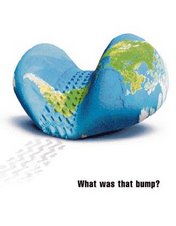
Instead of Earth Day, or the even more PC Earth Week, why don't we just change our habits permanently? Like a dieter who yo-yos back and forth between skinny and fat, hopping on each new fad diet as it comes along, we talk about environmentalism as if one day or week could possibly have an impact. We can't go on a fad diet, we need real change and it needs to become permanent. Biofuels are a fad diet. Hybrid cars are a fad diet. Ethanol is a fad diet. Biodiesel cars are a fad diet. Shopping for 'green' products is a fad diet. We don't need an Earth Day. We need an Earth Life.
Let's face it, we can't 'conserve oil', compost, recycle or 'buy green' our way out of this crisis. The only solution is a massive restructing of our society, which is coming, whether we like it or not. It is coming because the end of cheap energy is here. Shipping our cheap food over massive distances, cheap air travel, cheap commuting in a car, cheap 3000 sq foot house heating bills, all of that is over. $4 a gallon gas is 2 months away according to the latest predictions.
Everything is going to change as oil gets more expensive, which in my mind, is a very Good Thing. People aren't going to change their habits unless they HAVE to. And believe me, we are all about to have to.
There is no substitute for oil that is going to allow us to keep living the way we have been. There just isn't. The only solution is to use less energy because to do otherwise is about to become prohibitively expensive.
I recently read an article somewhere about how companies have convinced us that the way to save the environment is to save our own families by buying certain products, etc. For example, people buy water from a water company because our tap water is 'unsafe'. Or they buy organic food. Or they buy an organic mattress. While there is nothing inherently wrong with these things, in fact I support it, it does smack of saving yourself and saying screw it to everyone else. If water isn't safe to drink, we need to do something about it, not just buy bottled water. Its kind of like the yuppification of environmentalism. Instead of a movement, we just have another offshoot of consumer culture. I really think a lot of people have bought into this idea that you can 'help' the earth by 'going green'. I've said it before and i'll say it again, every time you buy ANYTHING you hurt the planet. Not consuming is the only solution. You don't help the earth when you buy an organic cotton shirt, a Prius, a box of organic crackers, an energy star diswasher, or anything else. You only hurt the earth less than the standard counterpart. Consuming is not the answer. It has never been. Not buying is the only solution...we need to strive for that ideal, as hard as it may be.
I was teaching my juvenile delinquent students at the night school the other night, and I decided since it was Earth Day that I would focus on environmental issues. We were talking about carbon footprint and how to reduce it, and I showed them how to calculate it. It occurred to me then, as it often does, how incredibly horrible our family is doing at the whole car thing. The weather this spring has been terrible and I've been so not wanting to ride my bike or walk anywhere long distance. We are doing great on every other front, with the exception maybe of food packaging, which I still find practically impossible to reduce further, except car driving. And if you want to feel REALLY depressed about our future, try talking to some high school students. So many of these kids, the vast majority, are so self-absorbed, instant-gratification junkies that they don't care at all about their impact on the planet. They are obsessed with material things. I know some of it is just their age, but I can't help but think that a LOT of it is how we are raising our kids: in front of the TV, exposed to commercialism everywhere, 5000 advertisements a year, video games, IPods, cell phones, fast food, instant EVERYTHING. They get what they want when they want it. They never have to delay their immediate desires. It's sad. Even the poorest kids I work with have an IPod and a cell phone and eat junk food at almost every meal.
Our plans for the near future involve moving to a smaller town. I sincerely hope that this reduces our need to drive. Not that portland is so big, or doesn't have great mass transit, but it is just big ENOUGH that riding your bike everywhere is a pretty big challenge. Riding the bus and transferring all over the place with 2 kids is a similarly daunting challenge. I think my "Earth Life" challenge is going to have to include a limit on mileage...we are going to have to set a limit, such as 50 miles per week in a car, and stick to it. So if we want to drive to salem, we pretty much just used up our whole week's rations in one go. If we want to drive around town, we need to keep track of it and stay below it. Our family has done a lot of work, but giving up or reducing our car use has pretty much....well, it's just not happening. Now if gas is $5 a gallon, i'm pretty sure i'll be thinking differently...
Oh, and we bought a new laptop. GOD! i'm such a hypocrit! we are all hypocrits. How do we live in this society and not trash the planet? Sometimes it feels like the most impossible task on earth. I'm sure the parts to make this laptop were mined by 12 year olds in South Africa.
So...how's that for an uplifting Earth Day message? I just can't stand it when people's solution for earth day is to buy an organic cotton earth day t-shirt. Yeah, that's gonna save us all.
Showing posts with label reduce waste. Show all posts
Showing posts with label reduce waste. Show all posts
Thursday, April 24, 2008


Saturday, March 1, 2008
How to make your own laundry soap
You can easily make your own laundry and/or dishsoap. Here's the recipe. Jay did this today. It ends up costing you 1 cent per load. You make something like 20 gallons per batch. All that's in it is laundry soda (sodium carbonate), borax, and some kind of castille soap. Easy. And fun! And you can add your own essential oil, so it can smell like whatever you want.
http://www.thefamilyhomestead.com/laundrysoap.htm
We ordered soaps off that other website. We got shaving soap for jay (old school with the shaving brush style), a shampoo bar and a conditioner bar. Oh, and a bag of remnants for hand-washing soap.
By the way, we went to IKEA last weekend. I know, why? We just kind of wanted to see it. I also wanted to get a hamper for elsie's room. It was such a scary experience. Its like 5000000 square feet of crap made in china with a hip flare. I did buy a kids hamper ($5) and a shoe shelf to organize our closet ($9). bad, bad me. Still, I wonder how many people get out of Ikea having only spent $15? I don't plan to go back. I still feel bad about supporting that kind of thing. We have bought almost nothing new in like a year....blah! Oh well.
Wednesday, February 20, 2008
Plastics...again
I'm readng this book right now called "The World Without Us" which is this kind of cool thought experiment about what would happen to civilization if humans just disappeared today. What would happen to buildings, roads, farms, power plants, oil refineries, etc.
One chapter was about polymers, what will happen to plastics. Right now...nothing would happen to them. There is no mechanism to break them down. They can get smaller and smaller, but they never go away. As they get smaller, animals eat them at all levels of the food chain. Some particles are so small that krill and plankton eat them. Some companies make facial "srubs" that contain tiny plastic beads...these wash directly into waterways where the smallest members of the food chain eat them.
The worst thing in that chapter was about how much plastic is in the ocean...right now there is a floating "ocean" of plastic debris the size of the African continent in the middle of the pacific ocean. You can see it from space. Isn't that the most sickening thing ever?
Whenever I hold a piece of plastic in my hand...I can't help but think about where it came from and where its going. What did it take to make this, and what will happen to it when i throw it "away". Will it end up in the ocean, where some animal will eat it and die? Or will it just go to a landfill where it will likely remain for the next million years until some bacteria evolves to digest polymers? What toxins were poured into the air and water during its manufacture?
I want to stop consuming plastic, i really do. Is it even possible? What do we buy that comes in plastic, and is there an alternative?
Cleaning products
soap (like castille)
laundry soap
dish soap
shampoo/conditioner
food that comes in plastic containers like bottles of oil, etc.
food in plastic bags such as crackers, etc
bread bags
occasionally shopping bags
i think we can start getting shampoo, conditioner, and laundry soap in bar form. i'm looking into it.
food...we just need to recommit to not buying a bunch of packaged crap. sigh. its hard!
Tuesday, January 22, 2008
2008 goals and resolutions
Now that i'm substitute teaching full time, we have time to do projects around the house again and actually live mindfully again, instead of stumbling through each day like a sleep-deprived zombie. Our big project at the moment is organizing/decluttering our whole house. It sounds like a chore, but really it's not too bad. One of the side benefits of moving all the time is that you don't get a chance to accumulate too much stuff. We are just going through everything drawer-by-drawer and area-by-area and getting rid of stuff that we don't love/need/use. i'm really thinning out the kids' toys. Our house is so much easier to keep clean when there aren't 100000 little pieces of plastic laying around everywhere. My goal is to have all the counter space free of stuff that isn't used daily, as well as not having a junk drawer in every room. I want to reorganize our garage, too. Its scary in there. Since we will be moving sometime in the next 6 months, I want to only move things that we really need or want. Especially since the place will be smaller. Its nice to go back to basics, in a lot of ways, and be forced to do that by moving into a smaller space. It makes you consider each item and if its really valuable.
I've been reading several blogs about living without plastics. One of them is Living Plastic Free Although I don't think we could live TOTALLY plastic-free, i think we could cut it back by A LOT. Things like a loaf of bread, which now costs $4.39 (!?!) are bagged in TWO layers of plastic. Now that jay has the stay-at-home dad thing down, I am hoping we can get back into making our own bread. Its pretty easy, and its fun to do with kids. I think with just a few changes, we can get back to making less garbage. We've been somewhat reliant on disposable items such as diapers and food from Trader Joe's lately. But we shouldn't be at this point. The amount of garbage we've started to produce is just sad. Considering that we were down to like 1 bag of garbage a month. We make that amount each week now : ( So I would like our second goal of the New Year to be cutting back on all plastic, and especially cutting way back on stuff that can't be recycled.
Last weekend I took our worm bin and pulled some worms out and started a second worm bin. They are a little sluggish--i'm assuming because its cold out--and aren't eating a lot. But if we do move, its likely that we wont be able to have an outdoor compost bin. So i want to have two worm bins to take care of the kitchen scraps at least.
Monday, January 21, 2008
hayyy laaaadies!
just a short post to let all the women out there know about the best thing ever. why this is such a big secret, i'm not sure. but if you are interested in reducing/preventing waste AND not having...um...leaking issues during your period, you must go buy a diva cup or moon cup. it took me a while to get used to it, but now that i am, i LOVE it. it's expensive at first, but consider that you can use it for years.
http://www.divacup.com/
or
http://www.mooncup.co.uk/
just get one. i've heard that the mooncup can be more comfortable. i already got the diva though, so i'm committed to making it work. its just one more way to not buy disposable products. and i HATE wearing pads, cloth or disposable, so this is the only non-disposable alternative to that.
Saturday, June 23, 2007
Chemical cleaners
I emailed OXO because that is who made my travel coffee mug. I wanted to know what kind of plastic it was, and they emailed me back and said this:
I've been having a little slippage on the packaging front. I have found myself buying things that come in less-than-optimal packaging, such as those that cannot be reused or recycled. Our garbage amount hasn't increased a lot, but I still need to remind myself constantly about what I do and don't need to buy, and what alternatives there are. In the store yesterday, I almost bought two boxes of cereal because they were on sale, but then I changed my mind and bought the big bag of cereal that doesn't have a box instead. The bag still can't be recycled, but its better than twice the packaging.
So I have rid our house at this point of all "harsh", unnatural cleaning products. I really believe that anything can be cleaned with dilute vinegar. Anything that can't be cleaned with vinegar can be cleaned with baking soda. If that doesn't do it, vinegar AND baking soda will, or try using some Doctor Bronners soaps. They are REAL soap, not petroleum by-products. All the ingredients are now organic and fair trade. They have 18 or more uses when diluted including hand soap, dish soap, laundry soap, toothpaste, shampoo, carpet cleaner, all-purpose cleaner, etc. Its like the only cleaner you need. I personally wouldn't use it for toothpaste, though. It tastes gross. Baking soda works great for that. Here is a website with a list of recipes for safe, environmentally friendly cleaners for every use. Try the recipes out! Its cheaper than buying commercially-made products, too.
I got really freaked out by something I read about carpet cleaner. The last chemical cleaner I had was soap for our carpet shampooer (god, i wish our landlord would rip out that nasty carpet and put in some kind of hard flooring!!!!!!) and i cleaned our carpet with it, then read this thing about how carpet shampoo is horribly toxic to young children. Better for Emmett to eat dirt and dog hair off our carpet than eat that shampoo! Its horrible to think about. So i will now just put Dr Bronners in our carpet shampooer when we steam the carpet.
This website is really awesome--its where I found out about that carpet shampoo thing. Its called Children's Health Environmental Coalition (CHEC)
They talk about mitigating environmental risks for children in your house and outside of it. I could spend a long time looking at that website, as well as their parent website http://healthychild.org/ Even if you don't have kids, it has a lot of information about how to green up your house and lifestyle so you don't give yourself cancer when you are cleaning or eating.
Laura,So that would be #5. I'm glad to know it. I think its important that we let companies know that we are concerned about the way products are made.
There is no PVC in any of our food prep products. The interior of the
mug is made from Polypropylene.
Thank you,
OXO Consumer Care Center
I've been having a little slippage on the packaging front. I have found myself buying things that come in less-than-optimal packaging, such as those that cannot be reused or recycled. Our garbage amount hasn't increased a lot, but I still need to remind myself constantly about what I do and don't need to buy, and what alternatives there are. In the store yesterday, I almost bought two boxes of cereal because they were on sale, but then I changed my mind and bought the big bag of cereal that doesn't have a box instead. The bag still can't be recycled, but its better than twice the packaging.
So I have rid our house at this point of all "harsh", unnatural cleaning products. I really believe that anything can be cleaned with dilute vinegar. Anything that can't be cleaned with vinegar can be cleaned with baking soda. If that doesn't do it, vinegar AND baking soda will, or try using some Doctor Bronners soaps. They are REAL soap, not petroleum by-products. All the ingredients are now organic and fair trade. They have 18 or more uses when diluted including hand soap, dish soap, laundry soap, toothpaste, shampoo, carpet cleaner, all-purpose cleaner, etc. Its like the only cleaner you need. I personally wouldn't use it for toothpaste, though. It tastes gross. Baking soda works great for that. Here is a website with a list of recipes for safe, environmentally friendly cleaners for every use. Try the recipes out! Its cheaper than buying commercially-made products, too.
I got really freaked out by something I read about carpet cleaner. The last chemical cleaner I had was soap for our carpet shampooer (god, i wish our landlord would rip out that nasty carpet and put in some kind of hard flooring!!!!!!) and i cleaned our carpet with it, then read this thing about how carpet shampoo is horribly toxic to young children. Better for Emmett to eat dirt and dog hair off our carpet than eat that shampoo! Its horrible to think about. So i will now just put Dr Bronners in our carpet shampooer when we steam the carpet.
This website is really awesome--its where I found out about that carpet shampoo thing. Its called Children's Health Environmental Coalition (CHEC)
They talk about mitigating environmental risks for children in your house and outside of it. I could spend a long time looking at that website, as well as their parent website http://healthychild.org/ Even if you don't have kids, it has a lot of information about how to green up your house and lifestyle so you don't give yourself cancer when you are cleaning or eating.
Wednesday, June 13, 2007
Garbage update

Today we are setting out our 32 gal garbage can for the first time since May 10. I'm not totally sure that we even set it out on May 10, but since we have definitely gone over a month at this point, we have easily reached our goal of only setting it out once per month.
The three recycle bins we have are for paper, plastic/aluminum/tin, and a separate one for glass. Almost all of our waste has gone into these bins (we have been setting them out weekly still).
So what is in that garbage can? What is not?
What is NOT in our garbage can: any recyclable container (plastic, even those that aren't curbside-able, we take to New Seasons to recycle--things like soy yogurt tubs, tofu tubs, etc.), glass, any paper product, any disposable item (save for the last of elsie's disposable pull-ups, we use hankies instead of kleenex, no paper towels, napkins, plates, no pads/tampons, etc), any food waste, any pet poo or cat litter (those get buried), any reusable item (such as margarine tubs that can be used as tupperware, plastic bags that can get re-filled at the bulk bin), any plastic bags (any we don't re-use have been recycled).
What IS in there, then? Plastic bags that are not reusable, such as those in boxes of cereal. I have really minimized my consumption of these things. However, we shop at a food liquidator because it is very, very cheap, and most of those products are packaged. So that is where those things came from. Pet food bags are in there--they aren't recyclable and there is no alternative. Bulk dog food doesn't work (we'd need to buy the whole bin). I guess we could make our own dog food but...yeah. I'm not quite there yet. Some disposable items that i can't find an alternative to such as Q-tips (any ideas?) , Lids to containers that are recyclable (you can't recycle glass jar lids, plastic tub lids, etc.) There is probably some other stuff in there that I am forgetting.
I want to try to go a month and a half before we set it out again...
Tuesday, June 12, 2007
Fake Plastic Trees
So I was talking to a friend a few weeks ago, who was telling me about plastic products and how some of them are being shown to contain Very Scary Chemicals. I had heard about this in regards to baby bottles, but didn't pay much attention since my kids never really had bottles. Well, I have since also gone to the pediatrician (anyone who is counting out there, Emmett is still like 93rd percentile for weight, weighing in at 20 lbs 11 oz at 6 months) and she was mentioning the plastics thing again. I have been confused, but now I know the deal, and so I am going to share it with you.
I heard a story on NPR the other day about plastic water bottles. A shocking and sad statistic is that only 23% of these individual-portion water bottles get recycled. And these bottles, recycled, are just as valuable as the first-run versions! Everyone wants these recycled bottles. It is sad when there is such a demand for a post-consumer recycled product, but nobody is recycling it. Well, people shouldn't buy their water in freaking little bottles, either. I mean, really! You can bring a bottle with you and re-fill it, or if you don't like tap water, fill it at home. Bottled water is the biggest rip-off ever. Brands like Aquafina and Dolsane (or whatever they are called--the coke and pepsi bottled waters) aren't even "spring" water. They are just purified tap water. If you really can't do tap, then buy it in huge, re-fillable 10 gallon jugs. You can even get it delivered! I, myself, like tap water.
Ok, so back to the thing about how plastics are scary. Here is the deal: many plastics contain a chemical called Bisphenol-A or BPA. This chemical is an endocrine-disrupting hormone that probably causes cancer, early puberty, developmental delays in children, etc. There is evidence that this chemical leeches into foods we eat or liquids we drink from the plastics that contain it. But there is good news! Not all plastics contain it. Sadly, almost all baby bottles and sippy cups do. So the most vulnerable among us are the ones getting it. What is wrong with people? Why are we putting Scary Cancer-Causing chemicals in baby bottles?
So here is the break-down. Look at the bottom of your plastic cup, tupperware container, or sports bottle. If it is a #7, it probably contains BPA and you should get rid of it. THIS INCLUDES NALGENES. I know, i know. Its sad and horrible. We all thought lexan was the greatest thing ever. Plus, all those healthy people carry their Nalgenes with them wherever they go. But they are not safe. Especially not for hot liquids. I cringe when I recall that i have put coffee in mine on more than one occasion. #7 plastics are ok if they are labeled "bio-based" plastic.
There are several other kinds of plastics we should not use. We should not buy them because they should not be made. We do not want these Scary Chemicals in our environment, in our children's bodies. It is unacceptable to use these chemicals, and the makers need to know that.
#3 plastics: Bad. contains DEHA (di(2-ethylhexyl)adipate) which is known to cause liver cancer. With a name like that, you know you shouldn't be using it! Also found in cling-wrap. Don't use cling wrap. Especially don't microwave it! This chemical is now found in our air, food, water and bodies. Not ok. #3 is also PVC or polyvinylchloride. This is a bad, bad thing. We do not want PVC in our lives. If your children's toys contain PVC, please do them a favor and get rid of them.
#6 plastics: Bad. Contain styrene which is toxic to the brain and nervous system.
Again #7 plastics, Bad. So many studies show this. Get rid of it. Don't buy it.
Go look at your child's sippy cup. If it says #3, 6, or 7, get rid of it and replace with:
Plastics #1, #2, #4 and #5 are all OK. No known endocrine-disrupters. No cancer. They are still plastics, but they are less evil than the other ones.
If you need alternative sippy-cup sources, please check out this great blog article on the subject. There is also a company called "Born Free" that is making BPA-free bottles and sippy cups. I'm too lazy to google it. You do it! If you aren't sure because it isn't labeled, this quick test will let you know whether your stuff contains BPA--is it hard and clear? Or is it squishy or soft-ish and cloudy? If it is hard and clear (think colored Nalgene) it contains BPA.
Here is a full article about which plastics are ok and which aren't and more info on why they aren't ok.
While you are at it, get rid of your teflon pots and pans. Teflon is also a Scary Cancer-Causer.
We are slowly replacing everything teflon with stuff that is stainless steel. We are getting rid of all plastic things and using glass, stainless steel or the safer plastics.
Monday, May 28, 2007
Tuesday, May 22, 2007
10 things to never buy again
I think part of the difficulty I face with my goals is a total 180-degree shift in thinking required when it comes to convenience. It has never before in the history of man been easy or convenient to transport oneself 10 miles. Until the early 1900's, the only way to get there was by foot, by horse, or by boat. Only in the last 70 years or so could anyone even dream that going 60 miles is a short trip that is no big deal. Heck, some people do it every day for their commute.
My point is this: When we examine the things we aren't willing to give up or change its often because we feel a sense of entitlement. Like, well, I have to have my (insert thing of convenience here). Thinking about the course of history, has anyone at any time in any location ever had the kinds of choices and privileges that we have? Of course not. I think that we will be forced to give up many of these things as we see cheap oil become a thing of the distant past. So, if we will be forced to give up our convenience items (an easy drive to wherever, a piece of fruit in the middle of winter from a far away country, a coffee from Starbucks each day, a cheap flight somewhere) why not try to give them up now, and find another more sustainable alternative? Humans have the nasty habit of waiting until AFTER they have smashed into a brick wall to make some tough decisions. It is a lot less painful to change course before the smash happens.
So when I think "but I won't be able to easily get over to my friend's house if I don't drive"--well, maybe I shouldn't be able to get there so easily. Maybe I have only been reliant on a false easyness-- one that has been subsidized by the environment of future generations.
Maybe I should have to curtail my activities, or at least take longer to get there. Maybe we shouldn't be living 40 miles from our jobs. Or eating mangos. I should be forced to pay more money for shade-grown, fair-traded, organic coffee. And I should do it now (and I do, ok?!!?)
We need to look at the things we need and the things we "need" and ask ourselves: can I do without? Am I willing to pay a very large sum of money for this if I'm not? Because that is the real cost of it. If you aren't willing to pay $10 for a piece of beef, then you shouldn't eat it. Because that is the piece of beef with the environmental damage, greenhouse gas emissions, loss of antibiotics for actual diseases, illnesses with e. coli treated, and so forth, built into it. Am I willing to pay $10 a gallon for gas to drive over to my friend's house? (Depends on which friend, right?)
Some habits are hard to change. Some are easy. Such as: Never buying anything listed on the list below ever again. Do you have a "right" to use paper towels? Of course not. 150 years ago no such thing could have even been dreamed of. So let's all do a 180 and ask ourselves if we can give up some conveniences. We aren't entitled to them, we're just used to them.
1. Styrofoam cups
Styrofoam is forever. It's not biodegradable.
Alternative: Buy recyclable and compostable paper cups.
Best option: Invest in some reusable mugs that you can take with you.
My point is this: When we examine the things we aren't willing to give up or change its often because we feel a sense of entitlement. Like, well, I have to have my (insert thing of convenience here). Thinking about the course of history, has anyone at any time in any location ever had the kinds of choices and privileges that we have? Of course not. I think that we will be forced to give up many of these things as we see cheap oil become a thing of the distant past. So, if we will be forced to give up our convenience items (an easy drive to wherever, a piece of fruit in the middle of winter from a far away country, a coffee from Starbucks each day, a cheap flight somewhere) why not try to give them up now, and find another more sustainable alternative? Humans have the nasty habit of waiting until AFTER they have smashed into a brick wall to make some tough decisions. It is a lot less painful to change course before the smash happens.
So when I think "but I won't be able to easily get over to my friend's house if I don't drive"--well, maybe I shouldn't be able to get there so easily. Maybe I have only been reliant on a false easyness-- one that has been subsidized by the environment of future generations.
Maybe I should have to curtail my activities, or at least take longer to get there. Maybe we shouldn't be living 40 miles from our jobs. Or eating mangos. I should be forced to pay more money for shade-grown, fair-traded, organic coffee. And I should do it now (and I do, ok?!!?)
We need to look at the things we need and the things we "need" and ask ourselves: can I do without? Am I willing to pay a very large sum of money for this if I'm not? Because that is the real cost of it. If you aren't willing to pay $10 for a piece of beef, then you shouldn't eat it. Because that is the piece of beef with the environmental damage, greenhouse gas emissions, loss of antibiotics for actual diseases, illnesses with e. coli treated, and so forth, built into it. Am I willing to pay $10 a gallon for gas to drive over to my friend's house? (Depends on which friend, right?
Some habits are hard to change. Some are easy. Such as: Never buying anything listed on the list below ever again. Do you have a "right" to use paper towels? Of course not. 150 years ago no such thing could have even been dreamed of. So let's all do a 180 and ask ourselves if we can give up some conveniences. We aren't entitled to them, we're just used to them.
1. Styrofoam cups
Styrofoam is forever. It's not biodegradable.
Alternative: Buy recyclable and compostable paper cups.
Best option: Invest in some reusable mugs that you can take with you.
2. Paper towels
Paper towels waste forest resources, landfill space, and your money.
Alternative: When you do buy paper towels, look for recycled, non-bleached products. Search the National Green Pages™ for recycled paper products.
Best option: Buy dishtowels or rags to wash and reuse.
3. Bleached coffee filters
Dioxins, chemicals formed during the chlorine bleaching process, contaminate groundwater and air and are linked to cancer in humans and animals.
Alternative: Look for unbleached paper filters.
Best Option: Use reusable filters such as washable cloth filters.
4. Overpackaged foods and other products
Excess packaging wastes resources and costs you much more. Around thirty three percent of trash in the average American household comes from packaging.
Alternative: Buy products with minimal or reusable packaging.
Best Option: Buy in bulk and use your own containers when shopping.
5. Teak and mahogany
Every year, 27 million acres of tropical rainforest (an area the size of Ohio) are destroyed. Rainforests cover 6% of Earth’s surface and are home to over half of the world’s wild plant, animal, and insect species. The Amazon rainforest produces 40 percent of the world’s oxygen.
Alternative: Look for Forest Stewardship Council certified wood.
Best Option: Reuse wood, and buy furniture and other products made from used or salvaged wood.
6.Chemical pesticides and herbicides
American households use 80 million pounds of pesticides each year. The EPA found at least one pesticide in almost every water and fish sample from streams and in more than one-half of shallow wells sampled in agricultural and urban areas. These chemicals pose threats to animals and people, especially children.
Alternatives: Buy organic pest controllers such as diatomaceous earth.
Best Option: Plant native plants and practice integrated pest management. Plant flowers and herbs that act as natural pesticides.
7. Conventional household cleaners
Household products can contain hazardous ingredients such as organic solvents and petroleum-based chemicals that can release volatile organic compounds (VOCs) into your indoor environment, positing a particular danger for children. The average American household has three to ten of hazardous matter in the home. Don't use bleach in your home.
Alternative: Look for nontoxic, vegetable-based, biodegradeable cleaners.
Best Option: Try making your own green cleaner using vinegar, water, and castile soap.
8. Higher octane gas than you need
Only one car in ten manufactured since 1982 requires high-octane gasoline. High-octane gas releases more hazardous pollutants into the air, and may be bad for your car.
Alternative: Buy the lowest-octane gas your car requires as listed in your owner's manual
Best option: Make your next car purchase a hybrid. Or ditch the car and take public transportation, ride a bike, or walk.
9. Toys made with PVC plastic
70% of PVC is used in construction, but it is also found in everyday plastics, including some children’s toys. Vinyl chloride, the chemical used to make PVC, is a known human carcinogen. Also, additives, such as lead and cadmium, are sometimes added to PVC to keep it from breaking down; these additives can be particularly dangerous in children’s toys. PVC is also the least recycled plastic.
Alternative: Avoid plastics that are labeled as “PVC” or “#3.” Look for #1 and #2 plastics, which are easier to recycle and don’t produce as many toxins. Use sustainable construction materials.
Best option: Take action to tell manufacturers to stop using PVC plastics, especially in children’s toys.
10. Plastic forks and spoons
Disposable plastic utensils are not biodegradeable and not recyclable in most areas.
Alternative: Use compostable food service items. Companies such as Biocorp make cutlery from plant materials such as corn starch and cellulose.
Best option: Carry your own utensils and food containers.
Pregnant women, women of child-bearing ages, and children should be very careful when choosing fish due to high levels of environmental toxins including mercury found in many fish. Check out our Safe Seafood Tip Sheet to see what the environmental and health risks posed by different fish.
12. Rayon. Developed and manufactured by DuPont as the world's first synthetic fiber, it is made by from liquefied wood pulp. Unfortunately, turning wood into rayon is wasteful and dirty, because lots of water and chemicals are needed to extract usable fibers from trees. Only about a third of the pulp obtained from a tree will end up in finished rayon thread. The resulting fabrics usually require dry cleaning, which is an environmental concern as well as an added expense and inconvenience.
Much of the our rayon sold comes from developing countries, such as Indonesia, where environmental and labor laws are weak and poorly enforced. There is mounting evidence that rayon clothing manufacturing contributes to significant forest destruction and pollution in other countries.
13. Beauty/Body Care with Phthalates and Parabens. Phthalates are a group of industrial chemicals linked to birth defects that are used in many cosmetic products, from nail polish to deodorant. Parabens are preservatives used in many cosmetics that have been linked to breast cancer though more research is needed. Phthalates are not listed on product labels and can only be detected in laboratory tests. To be safe, choose products from companies that have signed on to the Compact for Safe Cosmetics.
14. Cling Wrap. Many people don't realize that cling wrap may be made with PVC. #3 PVC (polyvinyl chloride) leaches toxins when heated or microwaved and it is an environmental problem throughout its lifecycle.
15. High VOC Paints and Finishes. Volatile organic compounds or VOCs can cause health problems from dizziness to lung and kidney damage and are infamous for polluting both indoor and outdoor air. VOCs are found in products including paints as well as finishes used for wood, such a stains or varnishes. There are now a wide array of low or no-VOC paints on the market. Look for paints certified by Green Seal (http://www.greenseal.org/).
Sunday, May 20, 2007
Simple ways to make a difference
So last week was bike to work week. Maybe you missed it. That's ok, because you can still bike to work any day. I'm pleased to say that yesterday I biked over to a friend's house and then to the bar, whereas the week before I had driven. It didn't occur to me to bike, even though it was only like 3 miles the whole night . It just goes to show that we have to consciously make an effort to change these habits.
You can calculate your carbon impact here. The difference between driving 5000 miles per year and 8000 miles per year is a LOT. Our family apparently has a "much smaller impact" than the average. We still have an impact, of course. And find out about simple ways to save carbon emissions here, like unplugging devices when not in use. They use energy, even when they aren't on. Did you know that? I am going to turn my computer off at the power strip when not in use, unplug the coffee pot, microwave, and other things that I can unplug without moving a large piece of furniture. You can go one step further and become carbon neutral by offsetting your use.
One thing that is really awesome is CSAs: Community Supported Agriculture. This means you "subscribe" to a farm by giving your money directly to a local farmer, usually an organic, sustainable farm. Then you share in the risks, and the bumper crops, of that farm. It's a very awesome thing. We have done it for about 5 years. We aren't doing it this year because we are trying to grow most of our own produce. And I want to be able to choose our food at the farmer's market, instead of having to take what the farm is growing. But here is a list of Portland-area CSAs. We have personally done the 47th ave Farm and Pumpkin Ridge Gardens, and they are both great. If you don't live in Oregon, you can probably find a CSA near you.
Our first moral dilemma in terms of our goals comes this week because we have pledged to not buy anything new. Well, we have also pledged to make a very, very small amount of garbage. We currently use a disposable pull-up on Elsie at night because she wets a lot when she sleeps (even though she has been potty trained for a long time). I know that sounds weird, that a family with these goals would use a disposable diaper, but we have been through a lot with her (leaking cloth diapers, really smelly, morning battles over taking it off and washing the bum, etc) it was just getting to be too much. After 3 years of cloth diapering, we figured one disposable a day wasn't a big deal. Well, it still makes a pretty large amount of waste. Plus, we are obviously buying the pull-ups "new". Then they get thrown away. I have looked for a pull-up cloth nighttime diaper used, but they aren't as readily available as regular diapers. So i think we will have to buy them new. They are called Happy Heiny's (yes, all cloth diapers have stupid names having to do with butt). They are made by work-at-home-moms. I'm hoping we can just get by with two (wash them each morning, so its ready to go the next day).
Oh, and Elsie has decided after seeing them on two of her friends, that she wants flip-flops. Uhhh...i wonder if they have any at Goodwill right now? She wears size 8 or 9, if anybody out there has some laying around :)
Saturday, May 19, 2007
Change in mindset
I think for us, the biggest challenge is going to be the car thing. Its so easy to be reliant on the convenience of a car. I am always secretly hoping that gas will go up and up and up--over $5 a gallon, because it will force myself and others to change this habit. I think the way I am going to have to tackle this is to pretend, in most cases, that we don't have a car. Sadly we have two, although one of them may die at any moment and won't get replaced.
If I can get myself to pretend that we don't have a car, maybe I can get so used to not having one that when we do make the switch, it won't be a big deal.
I've noticed that flexcar now has a car on 52nd and division, which is a short bus ride from our house. We'd have to take our carseats on the bus, which would be a hideous hassle, but if we are only doing this once or twice a month, it wouldn't be that bad.
Sadly, it costs an insane amount of money to take a greyhound or train to salem, which is another time we drive (to visit family). So its not really feasible.
I just wanted to post these great links about ideas to reduce waste. We are planning on visiting the Wednesday farmer's market at People's Food Co-Op They also have square dancing on Wednesday evenings, so we can check that out as well. Elsie's music teacher's band Government-Issue Orchestra plays there sometimes.
Anyway, the reduce waste thing
Also, the how to stop junk mail thing. As you can see, they make it hard for you. But I got FIVE, yes count them FIVE credit card offers in one day last week. This has got to stop. So I think I will order little pre-paid postcards from the post office and send them to these addresses. Hopefully I can curtail most, if not all, the junk mail we get.
I did this for myself and Jay. I get the credit card offers, he gets the student loan consolidation offers. Often times we get about 10 of these a week. Its stupid. I also called this 1-888-5OptOut to stop pre-screened credit and insurance offers.
Here is a very cool list of where to buy recycled items and recycled gift ideas
Metro may have its problems, but you have to admit it's pretty cool.
Subscribe to:
Posts (Atom)